

A deep dive on diastasis recti.
Diastasis recti is a common condition related to pregnancy and postpartum… But I find that people are often a little too worried about it.
We’ll dive in on what it is, what causes it, and what to do if you might have it!
Before we get started… this condition has a lot of different names. Diastasis recti abdominis or DRA for short is often what PTs like myself call it. Some call it “belly gap” others call it diastasis or diastasis recti. Its all the same, so choose your favorite!
I’m going to call in DRA because it’s easier to type!
1. DRA happens in 100% of pregnancies that reach full term.
Mind blown? Well, it’s true! And here’s why:
During pregnancy, your abdomen adjusts, stretches, and mobilizes as your baby and belly grow. It has to!
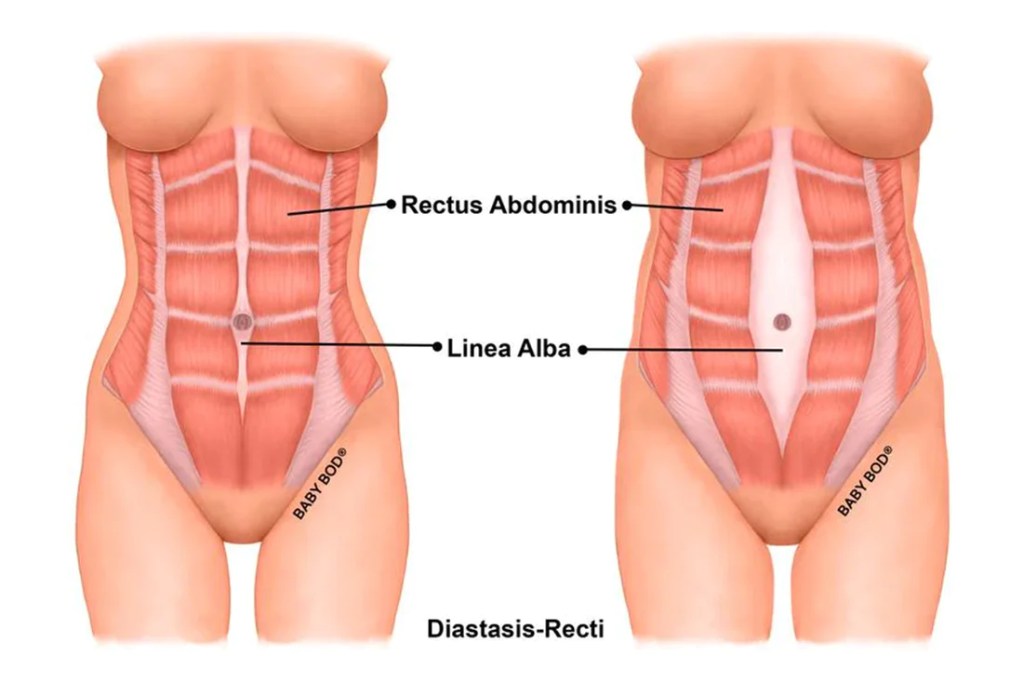
There is band of connective tissue, called the linea alba, that spans from the bottom of your sternum down to your pubic bones. The linea alba connects the R and L sides of your rectus abdominis muscle (think of it like a zipper).
During late pregnancy, the linea alba simply stretches to allow baby to keep growing. The stretching of this tissue creates a “gap” in your rectus muscles… i.e. diastasis recti.
(Diastasis is a medical term for “the separation of normally joined parts.”)
So… if you carry your baby to full term, you really can’t avoid DRA because it’s simply part of the process!
2. Even though you can’t avoid DRA, you can be aware of it.
As your baby bump grows, you might want to be aware of how you are moving. If you are doing a “sit up” type motion, either in exercise or in your daily life, look down and check on your belly. If you notice a bulge in anywhere along the linea alba, you might need to adjust your exercise routine or how you are moving. (People often call this bulge “doming” or “coning”).
The reason it’s important to modify in situations of coning, is that continuing movement in this way can create unnecessary pressure through the linea alba (which is already a bit stressed/stretched). Unnecessary pressure on top of a DRA might lead to longer-term issues.
For example, sitting up from bed- you might notice a coning situation. So, begin to modify by rolling to your side first, then using your arms to help you up.
Or, if you are doing core exercises in the gym or at home and you notice the coning, modify the exercise or stop it completely.

3. If you are postpartum and have DRA, consider your healing time.
If you notice a gap or coning and you are postpartum, this is for you!
A quick anatomy lesson: when your baby is living inside of you, your trunk and core adapts to the space they are taking up (hello shortness of breath, round ligament pain, bladder urge).
After you birth your baby (no matter how you birthed them), the anatomy that shifted out of the way, stretched, and reoriented doesn’t immediately go back to how it was pre-pregnancy.
It takes time for your tissues to heal, recover, and move back into their position. So… your belly muscles that stretched for 10 months take about 6 weeks to shorten back down. Your connective tissue (like the linea alba) takes even longer, because it doesn’t have the elasticity that muscles have.
So… if you’re starting to see the puzzle pieces come together. You might have DRA for a while after giving birth… which wouldn’t necessarily be out of the ordinary! This is anecdotal, but if you’re within 4-6 months postpartum and have a mild DRA, you will likely still heal fully by 18 months postpartum. Of course, special exercises and core/pelvic floor rehab will very much help you a long the way.
If you still have DRA after 18 months postpartum, it’s less likely that the tissue will return back to it’s pre-pregnancy state. And in that case, pelvic health PT is even more essential and will likely help you regain all function you need!
A side note: if you’ve had multiples or a condition called polyhyrdramnios, you are at a higher risk for chronic/permanent DRA. I highly recommend seeing a pelvic health PT during and after your pregnancy!

4. DRA can cause low back, hip, & pelvic floor problems!
The gap itself is not actually an issue… its how it effects the rest of your core and trunk muscles. In a nutshell, a DRA causes force distribution problems through your core and trunk. Which means that whenever your core muscles engage, the gap causes issues in how they distribute load through each muscle.
This can lead to muscle compensations and movement deficits which can cause pelvic floor dysfunctions like: leakage, pelvic pain, prolapse, voiding issues. It can also cause chronic hip or low back pain.
5. Pelvic health PT is the perfect solution to prevent and treat DRA.
Experienced pelvic health PTs have seen it all when it comes to pregnancy & postpartum conditions. We are uniquely trained in how to properly assess DRA and how the presence of one could affect different parts of your body. It’s important to have a specialized, hands on assessment for DRA due to the complex interactions it has with the pelvic floor, spine, pelvis, and hips. Depending on your unique situation, your plan of care will address each complexity with a DRA.
I hope this post is helpful and eases any nerves you might have regarding diastasis recti.
If you still have questions, feel free to send a message via our contact page. If you are local to SLC and interested in preventing or treating DRA, click below to schedule a free consult or evaluation.
Cheers, to understanding your body!
Sam